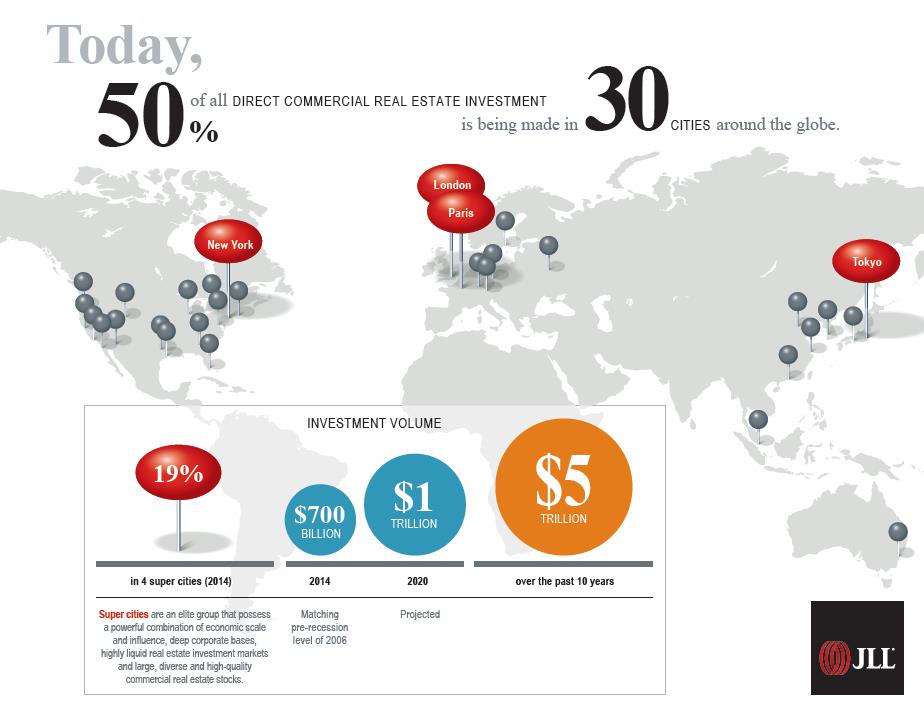
Research by JLL shows that as real estate investment reaches pre-recession levels, 50 percent continues to be concentrated in 30 cities worldwide
CHICAGO and LONDON, January 21, 2015 — An analysis
of the top cities for real estate investment continues to demonstrate
the contribution of real estate to the success of established and
emerging cities across the globe. According to research by JLL
(NYSE:JLL), total direct real estate investment is expected to have
reached US$700 billion in 2014, matching the pre-recession levels of
2006, and is projected to increase a further 5-10 percent in 2015 driven
by a robust economic environment.
As business and political leaders convene to discuss global issues at the World Economic Forum annual
meeting in Davos, Switzerland, there is a greater appreciation for the
importance of real estate in the global context. A look at the 30
cities worldwide where 50 percent of the US$5 trillion in direct
commercial real estate investments has been concentrated over the past
decade highlights the impact of real estate investment and investor
confidence on the strength of super cities and the growth of second-tier
cities. This is particularly evident in the four super cities – London,
New York, Paris and Tokyo -- where one of every five dollars of
commercial real estate transactions took place, representing 19 percent
of total global volumes.
 According
to Colin Dyer, CEO of JLL: “As real estate investment reaches the
levels last seen before the Great Financial Crisis, we are optimistic
about the positive impact of these investments on cities, in part, due
to the improved underwriting practices that have been put in place in
the last few years. We expect investments to continue to grow because
the market is on a sounder footing than it was before the recession and
has more robust controls and scrutiny on investments.”
According
to Colin Dyer, CEO of JLL: “As real estate investment reaches the
levels last seen before the Great Financial Crisis, we are optimistic
about the positive impact of these investments on cities, in part, due
to the improved underwriting practices that have been put in place in
the last few years. We expect investments to continue to grow because
the market is on a sounder footing than it was before the recession and
has more robust controls and scrutiny on investments.”
Direct real estate investment is expected to continue increasing to approximately US$1 trillion by 2020 driven by:
- Improved
controls including reduced reliance on leverage, greater use of equity,
stricter under-writing standards and increased scrutiny by investment
committees
- The emergence of new sources of capital, primarily in Asia and other emerging economies
- Increased
allocation to direct real estate from institutional investors in
developed markets due to low interest rates and an evolving regulatory
environment
- Growing cross- border investments from South Korea,
China, Taiwan and Malaysia spurred by government efforts to reduce
domestic overexposure by moving capital offshore
Recent research from
JLL identifies the continued importance of the four global super cities
while second-tier tech rich cities in Europe and the United States grow
and attract investors.
• The dominance of the super cities for
total and cross-border investment in 2014 was driven partly by single
asset mega-deals – such as the Gherkin and HSBC office towers in London,
Pacific Century Place office tower in Tokyo, the Waldorf Astoria hotel
in New York and the Marriott Champs Elysees hotel in Paris.
Interestingly, two of these deals were secured by
high-net-worth-individuals, an emerging class of investors who are able
to challenge and beat institutions for trophy assets in the main global
cities.
• The underlying shift in investor activity toward
second-tier cities also continued. This is most apparent in Europe
where, for example, the number of transactions in London and Paris fell
by 17 percent year over year, but increased by 37 percent in the next 20
largest investment destinations.
• In Northern Europe, mid-sized
cities – notably Dusseldorf, Hamburg and Munich (Germany), Amsterdam
(Netherlands), and the Nordic capitals of Oslo and Copenhagen –
experienced high levels of investment volumes as a proportion of city GDP.
These transparent and stable real estate markets with strong technology
and environmental credentials are attractive to corporate tenants and
investors.
• In Europe, investment volume growth also extended to
cities such as Dublin and Madrid, which were considered almost
un-investible just a few years ago. Dublin jumped to 24 in the global
investment hierarchy from 93 in 2013 and has the world’s fastest growth
in office rents over the past year.
• In the U.S., transaction
volumes shifted to the primary gateway cities of New York, Los Angeles,
Chicago, San Francisco, Washington, D.C. and Boston, reversing a trend
toward secondary cities seen in 2012 and 2013. Commercial real estate
investment volumes in primary cities were up 66 percent year over year,
compared with 37 percent for the U.S. market as a whole.
• Some
U.S. secondary markets such as Philadelphia, Miami and Charlotte did
experience increased interest from domestic institutional buyers.
Foreign buyers, on the other hand, are not as active in most secondary
cities yet outside of trophy, core-plus deals. Transaction volumes in
secondary cities are expected to increase in 2015 driven by an increase
in assets for sale.
• Most pan-Asian investment was focused on the
major cities of Tokyo, Sydney, Melbourne, Hong Kong, Singapore, Seoul,
Shanghai and Beijing. With a lack of volume growth across the region in
2014, there was less appetite for secondary city opportunities outside
of trophy or core opportunities due to lower transparency and market
accessibility.
• Multi-family assets have been a focus of
investor activity in the U.S. and interest in these properties has
spread to countries such as the UK and Australia. Additionally, Chinese
residential developers have expanded aggressively into overseas markets
in recent years, with a focus on London, New York, San Francisco,
Toronto and Sydney.
About JLL
JLL (NYSE: JLL)
is a professional services and investment management firm offering
specialized real estate services to clients seeking increased value by
owning, occupying and investing in real estate. With annual fee revenue
of $4.0 billion and gross revenue of $4.5 billion, JLL has more than 200
corporate offices, operates in 75 countries and has a global workforce
of approximately 53,000. On behalf of its clients, the firm provides
management and real estate outsourcing services for a property portfolio
of 3.0 billion square feet, or 280.0 million square meters, and
completed $99.0 billion in sales, acquisitions and finance transactions
in 2013. Its investment management business, LaSalle Investment
Management, has $53.0 billion of real estate assets under management.
JLL is the brand name, and a registered trademark, of Jones Lang LaSalle
Incorporated. For further information, visit www.jll.com.
Contacts